Quantum Behaviors
by Barry Carter
on
update
Over the
years the following “quantum” properties or behaviors have been
associated with the ORMUS elements:
1. Quantum Coherence/Instantaneous
Non-Local Communication
http://subtleenergies.xyz/ormus/tw/spincoherence.htm
http://subtleenergies.xyz/ormus/tw/coherence.htm
http://subtleenergies.xyz/ormus/tw/consciou.htm
2. Quantum Tunneling
3. Superconductivity
http://subtleenergies.xyz/ormus/tw/superconductivity.htm
http://subtleenergies.xyz/ormus/tw/denial.htm
a. Conductivity
b. Magnetic Levitation
c. Diamagnetism
d. Meissner Effect
http://subtleenergies.xyz/ormus/tw/levitate.htm
http://subtleenergies.xyz/ormus/tw/whyormus.htm
e. Energy Storage
4. Emergent
a. Matter/Weight Change
b. Energy
5. Low Energy Transmutation
6. Spectroscopic Invisibility
7. Superfluid Behavior
8. Condensed Matter/Bose-Einstein
Condensate
9. Cooper Pairing
EMERGENT
MATTER
Jim always
called this stuff "emergent matter" from the first time he told me about
getting his hands in the stuff in 1989. Here are some quotes from our
[JIM] On the outside like around the . . . had vinyl roof
and it's painted the same color. It was a Euro type finish and the paint came
off all the chrome. Just came right off. And you could see the stuff that was
gold finished of course it stripped down to the base metal wherever this stuff
run those polymers just picked up the gold. Same with the apartment I lived in.
They had to rip out the carpet and all that crap. There were picture frames
that were gold . . .there was this stuff that was creeping out of my acrylic
sweaters and stuff went across these . . . you could see where it ran across
all that . . .
[DM] Do you feel like it has a catalytic effect then?
[JIM] Undoubtedly! It made more. I didn't think I'd ever get
it quenched.
[BARRY] Do you feel it made more of the monoatomic
. . .
[JIM] I felt like I made more is what I felt like.
[DM] I'd say that was catalytic if it was pulling gold off
of the picture frames and off the trim on the car.
[JIM] Yes, just like the stuff I made to go get the gold,
the getter, never got shut down. That's how I took it. I couldn't shut it down;
it just kept on going and going.
[BARRY] The Sorcerers Apprentice.
[JIM] And I was still the carbon air cell for the stuff I
was sweating out. And that's when I started throwing away my clothes after
wearing them once. And that's when things started getting better.
Jim also
mentioned this in a recorded conversation on
Jim - It's such a tough thing to figure out whether or not
it's quenched. It seems to come back when you think it's gone.
Barry - Are there other things that it's affecting other
than . . .
Jim - Machinery, equipment and electronics? Nope. [We
laughed.] It's pretty bad, it looked quite lively.
In a
January 2002 post to this forum Kevin suggested that the oil of full moon dew
might be responsible for radical changes in the nature of certain reagents by
linking them to the quantum vacuum. Here is what Kevin wrote:
A target substance that has been affected by space
properties (quantum vacuum), such that its physical and chemical
characteristics are permanently altered. The new product has the capacity to
induce reagents it comes in contact with, to undergo changes over the course of
time (i.e. the changes are not in the first millisecond as most chemical
reactions are).
Example 'Vinegre' of Artephius . It is otherwise called 'mineral vinegar'. it is
essentially sulphuric acid altered by the quantum
vacuum such that it has a pH of around 0, will NOT precipitate Barium or Lead,
will combine with transition metals to form ethanol soluble, greasy salts, and
the pure 'vinegre' can be safely tasted on the tongue
(we call it 'lemon salt' after its pleasant sour taste), and distils at low
temperature (approx 100 deg C).
Such a demonstrated alteration of a substance by 'space' is
a clue to ormus state itself. It may in the end be
the harnessing of the quantum vacuum to alter any material substance- with
__________________________
According
to Kevin the "taste of the [full moon extract] greases ex ether is
'fresh'. The best way to describe it, is that it is the taste equivalent of the
smell of the first rain drops on parched earth- 'sweet', earthy, fresh."
SUPERCONDUCTIVITY
At least
three different forms of the ORMUS have exhibited behaviors which suggest
superconductive magnetic levitation. David Hudson reported that his ORMUS
iridium would levitate after it had been "annealed" for a dozen or
more times but that this effect did not last for more than a few days. Various
researchers have reported that the magnetic traps produce an "oil"
which is concentrated by the presumed superconductive magnetic levitation of
the ORMUS portion of the water out of the rest of the water. Jim's early
experience with the "fly ash" suggests that it was a superconductor.
Also, Jim made the m-gold which "jumped" away from a magnet on my
kitchen table.
Let's start
with the magnetic traps.
Kevin did
some early experiments with magnetic traps on bore (well) water. He was able to
extract a similar oil or grease from this concentrate.
Since the
magnetic trap was initially designed to spin water in a magnetic field and
concentrate the superconductive portion of that water we can presume that this
is further evidence of room temperature superconductivity.
Kevin also
built a magnetic trap specifically for the extraction of this
"superconductive" oil from the air. Since the oil was present in dew
he postulated that it might also exist in the air in lesser amounts. His
experiment was successful in extracting an oil from the air. You can read more
about these experiments at:
http://subtleenergies.xyz/ormus/tw/airtrap.htm
Jim, the
original inventor of the magnetic traps also had some profound experiences with
them which suggest that his postulate that the separation of the oil portion of
the water is based on the superconductive properties of that water. Using the
trap pictured below:

Jim was
able to extract four ounces of precious metals from a ton of the trap water.
Though his method is secret and not profitable he did give me some samples of
the metal that he produced from this trap water. One of these samples can be
seen below:
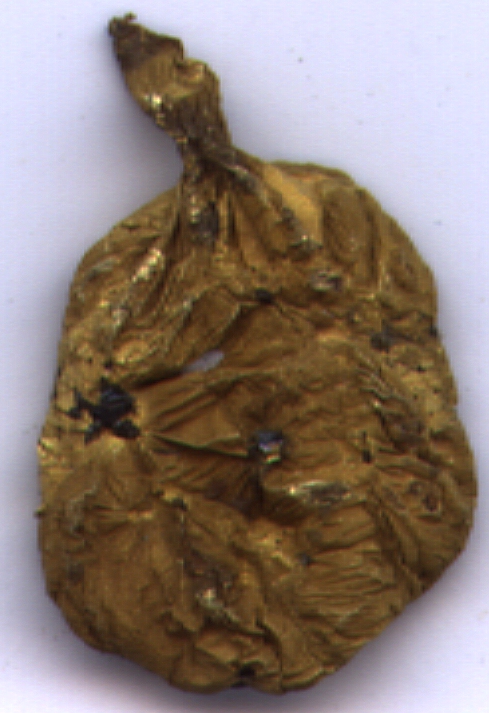
and another
can be seen below:
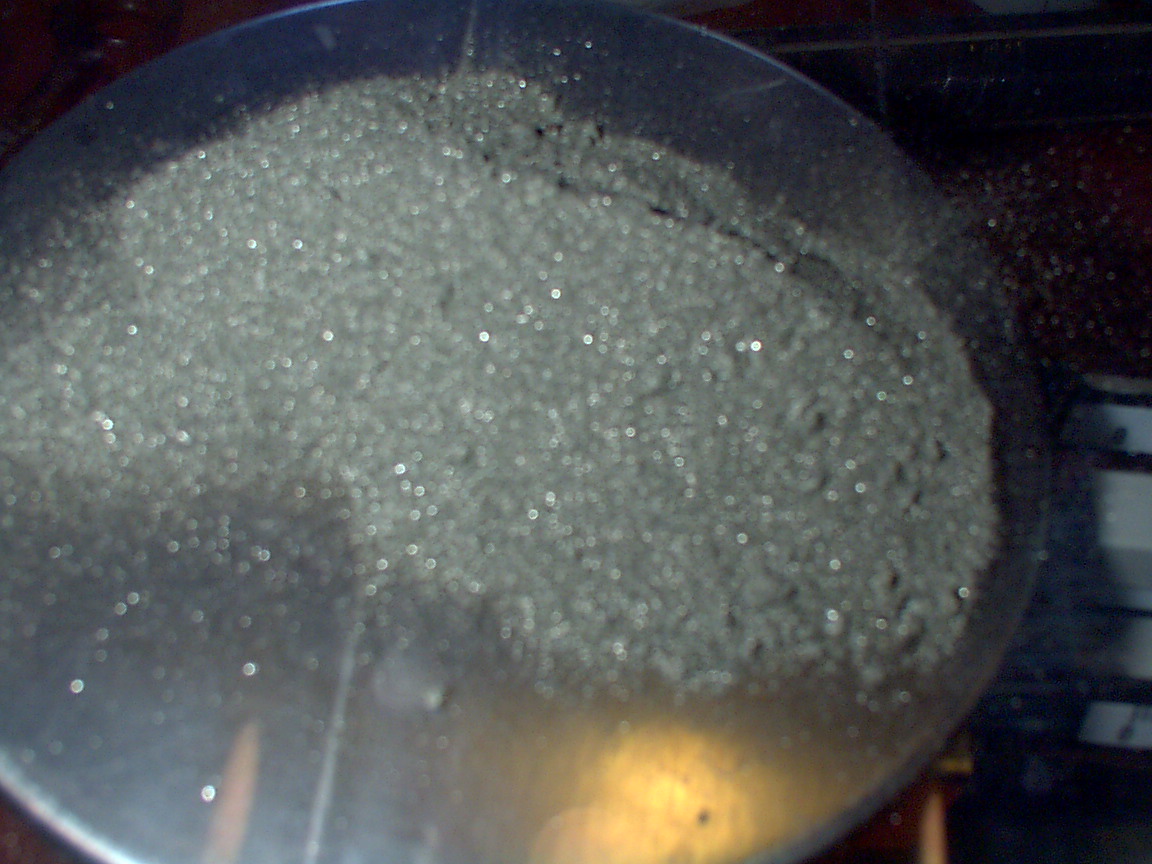
The second
sample is mixed platinates and is a portion of what
was sold to a precious metals dealer for several thousand dollars.
Also as a
result of Jim's early experiences with these materials we postulated that it
should be possible to make a form of pure gold which would levitate on a
magnetic field like any other superconductor. Jim took some ordinary gold
chloride and ozonated it with his special ozone generator and got the green
liquid pictured below:
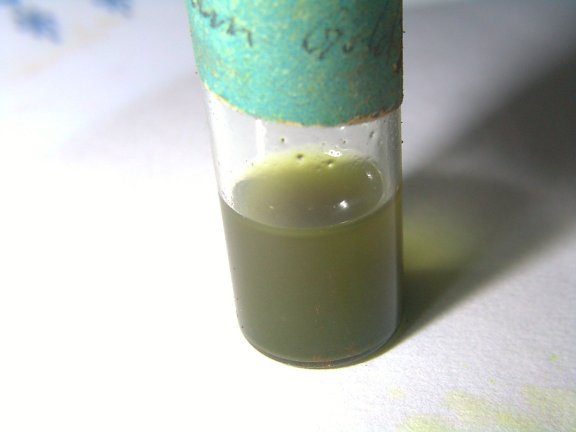
I worked
with him during this process and videotaped portions of the procedure. You can
see an image of the ORMUS gold at an earlier stage of this process below:
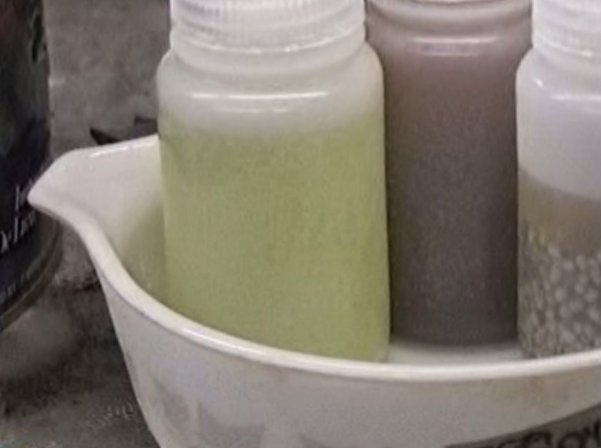
The m-gold
is to the left and the other two bottles are m-platinates
from catalytic converter beads. I still have some of these samples.
Jim gave me
a couple hundred milliliters of the green gold chloride solution in early 1996
and I dried a portion of it into a grey powder. On
http://subtleenergies.xyz/ormus/tw/JumpingAu.wmv
Jim and
others also tried the magnetic trap on ocean water since it was a good source
of the white precipitate that a few researchers have converted to gold. We
found that the ocean water did not respond to the trap as fresh water did. Jim
concluded that the salt somehow provided some magnetic shielding for the ORMUS
in the water. But, Jim postulated that a very strong pulsed magnetic field
should be able to overcome the shielding effects of the salt and get the ORMUS
to levitate out of an ORMUS rich salty solution.
Working on
this postulate, Jim took the large electromagnet pictured below:
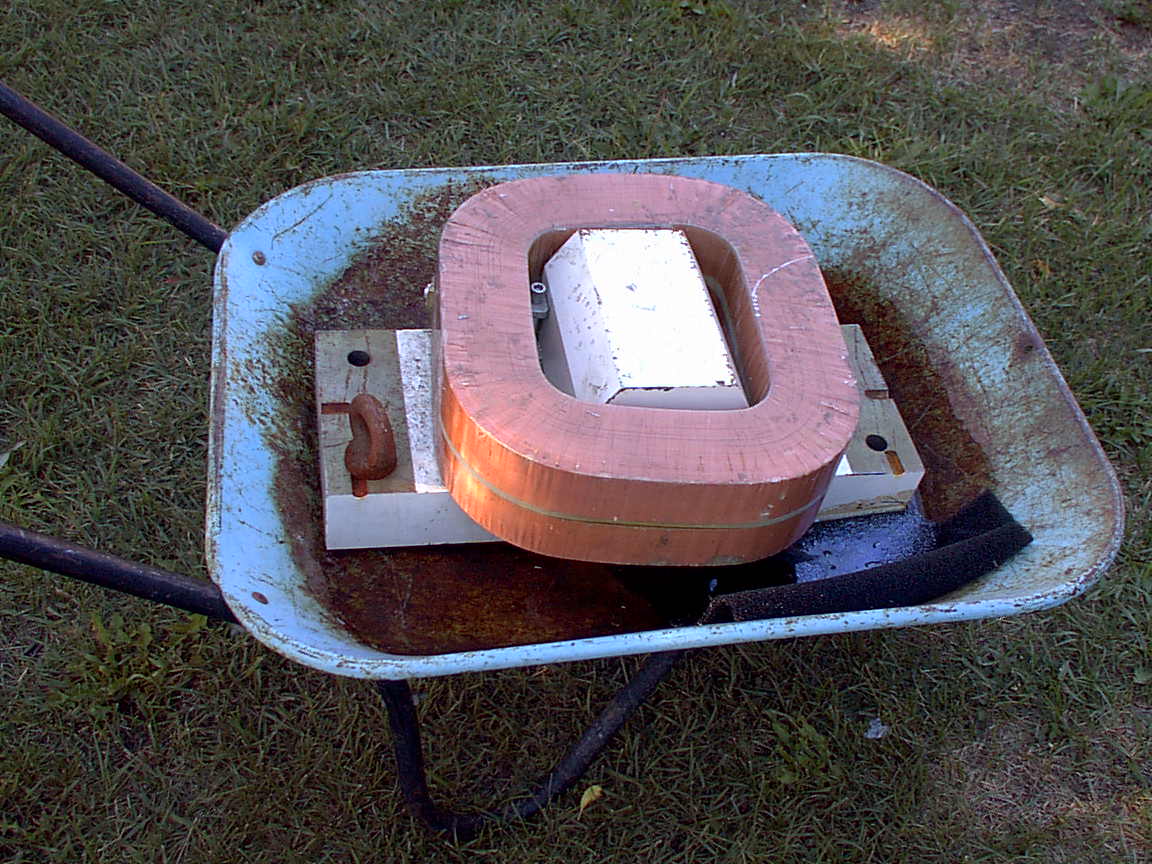
and pulsed it
into a solution of ORMUS rich liquid like the central jar of liquid pictured
below:
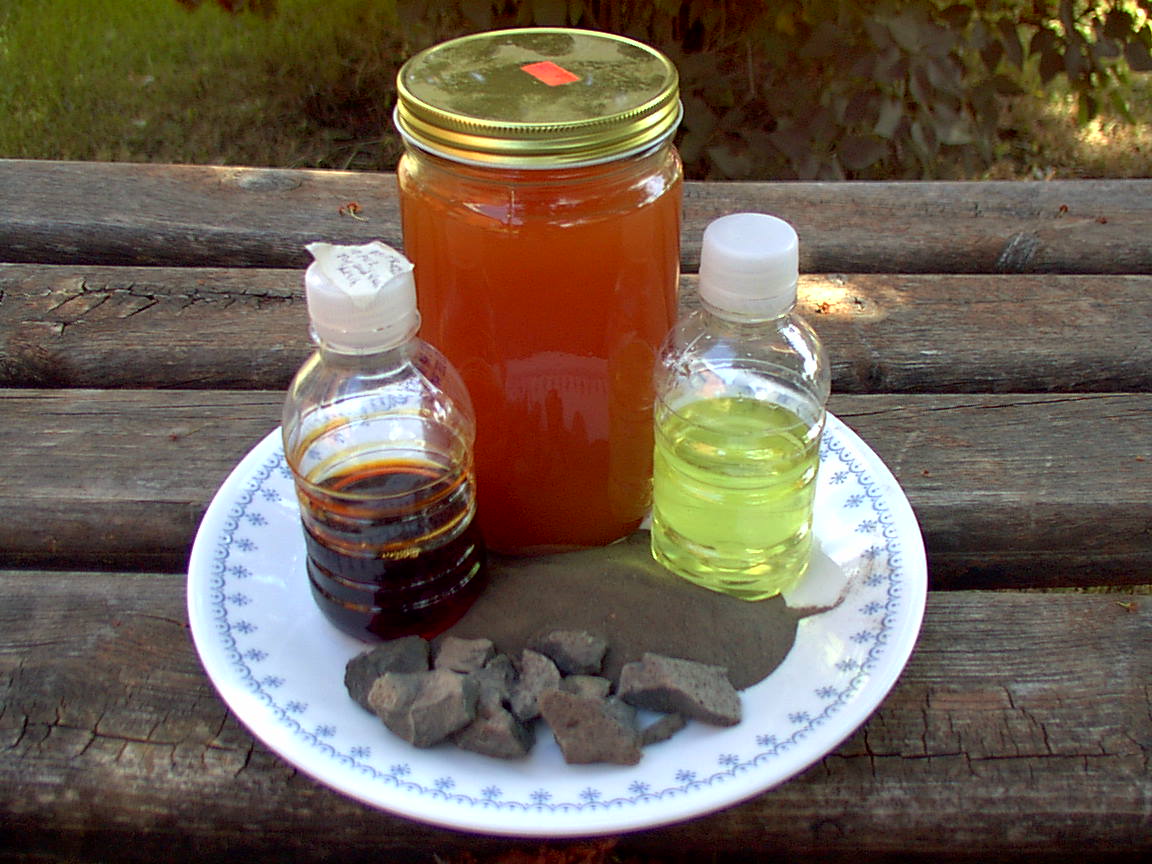
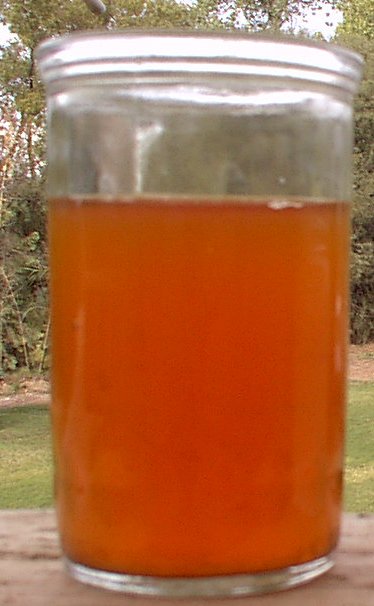
(Note the
similarity of color between this liquid and the pH adjusted
"chloride" form of David Hudson's natural source liquid below:
 )
)
Jim said
that he could get a rich ORMUS solution to "boil like gasoline" at
room temperature by hitting it with a 500,000 gauss electromagnetic square wave
pulse at 17hz on a 40-60% duty cycle.
He said
that the off-gas will condense in a magnetically shielded container as a grease
but that this grease will quickly "evaporate" when removed from the
magnetic shielding. You can read more of Jim's story about this effect at:
http://subtleenergies.xyz/ormus/tw/pmf.htm
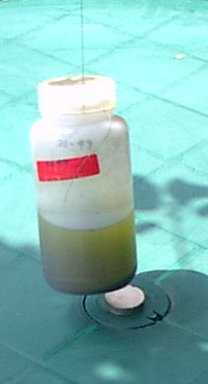
I remember
standing in the 30 foot trailer, which Jim lived in around 1996, and watching
Jim swing a bottle of ozonated ORMUS rhodium/iridium suspended on a thread over
a strong magnet on the table. Jim pointed out that the magnet would make a
slight "detour" away from the magnet as it went over it at the bottom
of the swing. Jim said that this was good evidence that the liquid was
superconductive. He suggested at that time that we should be able to use this
property of these materials to extract them from water and other liquids. I am
convinced that he was designing the magnetic traps in his head as early as this
time.
Swinging ORMUS
This is all
to show that Jim's theories about superconductive ORMUS elements in water had
predictive value and were eventually translated into success with the magnetic
traps, the pulsed magnetic field device and the jumping m-gold in the video.
JOSEPHSON
TUNNELING
During the
summer of 1989 Jim was using ozone on a mine waste clean up project and every
time I talked with him he told me more stories about strange things that
happened there. Jim told me about stuff that would disappear in a flash of
light, "fly ash" that would float away from your hands and a puddle
of water that would follow people around. I didn't think to write any of this
down at the time but I often encouraged Jim to tell these stories to others.
Our
original speculation about tunneling behaviors followed Jim's experiences in
the summer of 1989 after he got his hands in the energetic ozonated mine waste
water and as he opened them afterwards he had metal fibers coming out the backs
of his hands. At the time we did not know what had happened but in retrospect
we now believe that the high energy ORMUS tunneled into his hands from the
ozonated mine waste water and "condensed" as metal inside his hands
because in the process it lost enough energy for the cooper paired electrons to
be separated allowing the ORMUS to be "pinned" to metal by the carbon
in his hands. We suspect that a similar thing was happening when the gold
fibers grew inside the charcoal briquettes, when the paint job on his car got
its gold flake look and when the gasoline in his friend's truck jelled and
showed up with precious metal flakes in it. (The last event is how Jim learned
what boiling gasoline looks like as he boiled this jelled gasoline away to
recover the precious metal flakes.)
You can
read my account of Jim's experience at:
http://subtleenergies.xyz/ormus/tw/mystory.htm
In 1995
another friend who had heard Jim's stories contacted me to tell me about a man
named David Hudson who was telling stories about similar things. I attended
David Hudson's lecture and workshop in Portland, Oregon on July 28 & 29,
1995 and a few months later Jim, DM (a gentleman I met at Hudson's lecture) and
I sat down with a tape recorder and recorded the description of the events that
happened in Jim's life back in 1989. You can read the complete transcript of
the recording of our conversation at:
http://subtleenergies.xyz/ormus/tw/jimstory.htm
In some of
his presentations David Hudson also mentioned tunneling. Here is an example
from his first
[
I have
personally seen the material resulting from Jim's work "tunnel" out
of a sealed container on three occasions after being "stimulated"
with a rotating magnet.
I first
observed a few drops of liquid which escaped from a sealed Nalgene container on
about
http://subtleenergies.xyz/ormus/tw/jim01.jpg
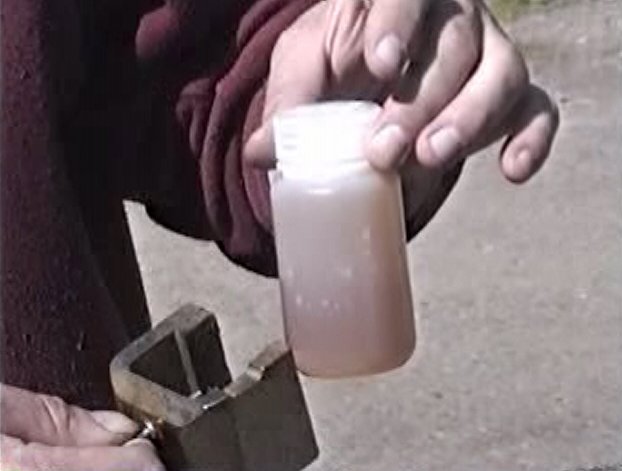
Here is a
note that I wrote to a colleague named
Dear Gary,
I was fooling around with the samples today when I found a
couple of drops of clear liquid on the bottom of the large coffee can with the
large liquid sample containers. This was between sample 29 and the bottom of
the coffee can. There was no way that liquid could have gotten in there by
normal means.
I "cleaned" this sample from the bottom of the
coffee can with my finger. This sample had the same viscous quality as the
other clear samples from between things. I tasted this sample and it had a
sweet taste similar to the other clear samples. Some of it was slightly salty
from the salt on the bottom of the coffee can. This sample could have been
generated by the magnetic field of the small super magnet that was attached to
one of the smaller tin can sample shields and placed in the sample coffee can
inadvertently. I dumped the salt from the bottom of the can and saved it as sample
48. Then I washed and dried the coffee can and replaced the sample containers. We
have speculated about the relationship of this material to manna.
I recently obtained about thirty samples of materials Jim
thought were interesting. A couple of samples stand out. (I have compiled my
notes on them into a database, if you think it would be of interest to you I
can send it along.) I have verified some of Jim's observations with
observations of my own. Jim claimed that after he "nuked" (ozonated)
a sample, if he sealed the sample in a bottle and exposed the sealed bottle to
a spinning magnet, often droplets of something would appear on the outside of
the container on the side away from the magnetic stimulation. I witnessed this
happening. Jim claimed the sample was rhodium and iridium from a catalytic
converter, along with some gold chloride, converted to monoatomic
by thirty minutes of ozonation.
A colleague
actually videotaped Jim doing this same thing at a later time. I still have the
video. You can see more stills from this video at:
http://subtleenergies.xyz/ormus/tw/jim02.jpg
through http://subtleenergies.xyz/ormus/tw/jim06.jpg
and http://subtleenergies.xyz/ormus/tw/jim17.jpg



It was a "fresh" batch in that Jim had just nuked
it immediately prior to my arrival. Presumably, it was a sample of monoatomic rhodium, gold and iridium in 25% HCl. He had me hold the 250 ml Nalgene bottle with the
sample while he moved a magnet under it. I noticed a slight pull from the
magnet. We put the bottle down and turned our backs for about five minutes and
the next time we looked at it, it had three or four clear droplets on the top. Jim
claimed that these droplets were oily, so I got one on a finger and it was
indeed oily. I tasted the tip of my finger and it tasted very pleasantly sweet.
I have tasted that same sweet taste in bottled spring water. They both leave a
pleasant sweet aftertaste.
Jim also gave me some samples of dried material in Petri
dishes. Most of these dishes were taped with electricians tape to keep the lids
on and the samples inside. I put 24 of these samples in the plastic bag that
the petri dishes came in and stacked them upright in
the back of my car. I drove them home (about 800 miles) and when I opened the
bag I noticed that there was some liquid on the inside of the bag. I set the
bag aside until I had a chance to look at it, about 2 days. When I went through
the Petri dishes I found that several of them had a clear oily liquid (about
the consistency of glycerin) between the Petri dishes. This liquid had the same
pleasant sweet taste.
I pipetted the liquid from between
the dishes into a 2 inch by half inch clear glass vial. I did the same with the
liquid on the inside of the plastic bag. When I pipetted
the material, it was so viscous that I could not blow it back out of the
pipette. I noticed some droplets of the, presumably, same liquid on the inside
of the lid of the 250 ml Nalgene container that I mentioned previously. Assuming
that this was probably the same material, I sucked a drop of it into the
pipette and immediately it reduced the viscosity of the other material
sufficiently that I was able to blow the rest of the pipette sample into the
clear glass vial. (When I, later, tasted the liquid from the inside of the
Nalgene container lid, it tasted like acid.) I now have a sixteenth of an inch
of this liquid in the bottom of the vial.
This is confirmation of Jim's claims that the clear,
"snotty" material often goes through the lids of bottles and that it
"likes" to collect between layers of stuff. Another sample, I
obtained from Jim, is a stack of about 6 glass slides held together with a
rubber band. Jim claims that he uses these as an exposure meter to determine
how much "monoatomic" gold gas has been
released into the room. The slide bundle I have looks like it has been dipped
into some salt brine and let dry. The stack of slides is in a taped petri dish. By shaking the Petri dish a bit, I was able to
break off some of the material that was encrusting the edges of the slides. These
white to light gray flakes are mildly magnetic. As is typical of these
materials, the magnetic response builds over the exposure time. I use a stacked
pair of quarter inch diameter rare earth magnet from Radio Shack to test for
magnetic properties. Some of the flakes are moderately magnetic the rest are
very slightly magnetic. (By magnetic I mean that they respond to a magnet, not
that they have a magnetic field of their own.)
Later I
responded further to
I was fooling around with the samples today when I found a
couple of drops of clear liquid on the bottom of the large coffee can with the
large liquid sample containers. This was between sample 29 and the bottom of
the coffee can. There was no way that liquid could have gotten in there by
normal means.
I "cleaned" this sample from the bottom of the
coffee can with my finger. This sample had the same viscous quality as the
other clear samples from between things. I tasted this sample and it had a
sweet taste similar to the other clear samples. I ate as much of this sample as
I could. Some of it was slightly salty from the salt on the bottom of the
coffee can. This sample could have been generated by the magnetic field of the
small super magnet that was attached to one of the smaller tin can sample
shields and placed in the sample coffee can inadvertently. I dumped the salt
from the bottom of the can and saved it as sample 48. Then I washed and dried
the coffee can and replaced the sample containers.
In July of
1997 I sent the following comment to several ORMUS researchers:
You may wish to store the glass containers in a mu metal shield. It seems that magnetic shielding is
essential to long term storage. Jim also stores his samples in the freezer
compartment of a refrigerator. Cheap nested metal containers like painted spice
containers make an excellent shield for this stuff. We have had glass
containers break at the liquid level as the result of tunneling action that is
focused at that level. We believe that some of the G-ORMEs
have enough energy to "tunnel" out of the glass container but that
some do not quite make it and get captured in the walls of the glass container.
This causes tiny fractures in this area which eventually weaken the container
causing it to break at that point. We store these materials in Nalgene containers
in preference to glass. Jim also says that the more acidic the solution the
better the storage ability. He suggests that they be carefully brought to a pH
neutral condition just before ingestion.
When kept in solution in a beaker as di-ozone
ORMEs complexes, when they leave the liquid phase at
the fluid interface, they do not go straight up into the atmosphere above the
liquid, but depart from the liquid along a vector which is dependent on their
departure velocity vector, and this vector is random through a 180 degree
umbrella. Because of the pseudo two dimensional interface between the container
and the liquid, this will naturally tend to be an area where significant
migration activity occurs. Because of this, the number of ORMEs
exiting along or immediately near the edges of the glass container will be
greater than for any other part of the liquid surface. It is also obvious that
particles exiting in this region will tend to strike the inner wall of the
container, just at or above the liquid level, since a large number of their
possible departure vectors will point them at that region, for that exit zone,
around the edge where the liquid/container interface or meniscus is.
Some percentage of the ORMEs
hitting this region of the inner container wall will tunnel, rather than
rebound. Should the tunneling ORMEs deozonate, as a result of local conditions in the amorphous
structure of the glass, than the resulting gold atom will become stuck there,
and its "appearance" will result in a localized stress riser, as a
dislocation in the glass structure. After enough of these stress dislocations
have accumulated in the same region, the glass will crack. In this case it
cracks in a nice clean ring.
Tunneling was occurring in other parts of Jim's glass beaker
walls also, but this was taking place at random locations, so the points of
added stress were spread out and more-or-less evenly distributed. Hence no cracking anywhere else. Glass containers should not
be used to store ORMEs solutions for prolonged
periods.
I saw one
of these broken bottles around this time. Here is a quote from another post I
wrote to Robert Cox on
Jim claims that fluctuating magnetic fields can cause the
m-state material to "tunnel" out of sealed containers as a gas. He
frequently has problems with containers breaking at the fluid level as some of
the gas does not have enough energy to "tunnel" all the way through
the container and will "materialize" inside the glass walls of the
container. This will create minute fracture points which will eventually join
and cause a relatively clean break at the liquid level.
I later had
another experience with a phenomenon that also looked like tunneling. This time
I was working with the red precipitate made from gold using my HCl/H2O2 method
described on July of 1997 at:
http://subtleenergies.xyz/ormus/research/goldto-m.htm
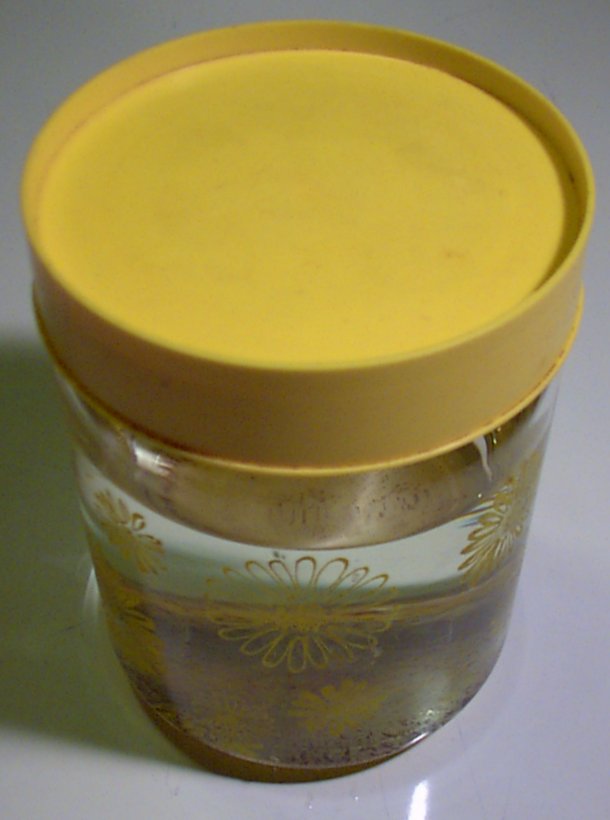
At
I concentrated the precipitate which dropped the quickest
and put the remainder in a quart glass canister with a plastic sealing lid. I
then set this canister on a magnetic stirrer which has a U shaped magnetic
element. When I turned it on I noticed that there were two or three particles
which seemed to move in response to the magnet. These particles, or
aggregations of particles, were somewhat elongated and had two motions. They
would spin around their internal axis at approximately the same speed as the
magnetic stirrer. They would also orbit around the center of the container in
an orbit which did not exceed an inch in diameter. This motion was much slower,
probably since the viscosity of the water prevented faster movement. I could
get these little structures to spin on their own axis quite rapidly simply by
increasing the speed of the stirrer. They seemed to maintain a distance of
about a quarter inch above the bottom of the glass canister.
Since this morning when I put the canister on the magnetic
stirrer there have been a couple of developments. The liquid has changed to
more of the brick red color. Not completely, just slightly. I also noticed some
liquid in the lid of the canister.
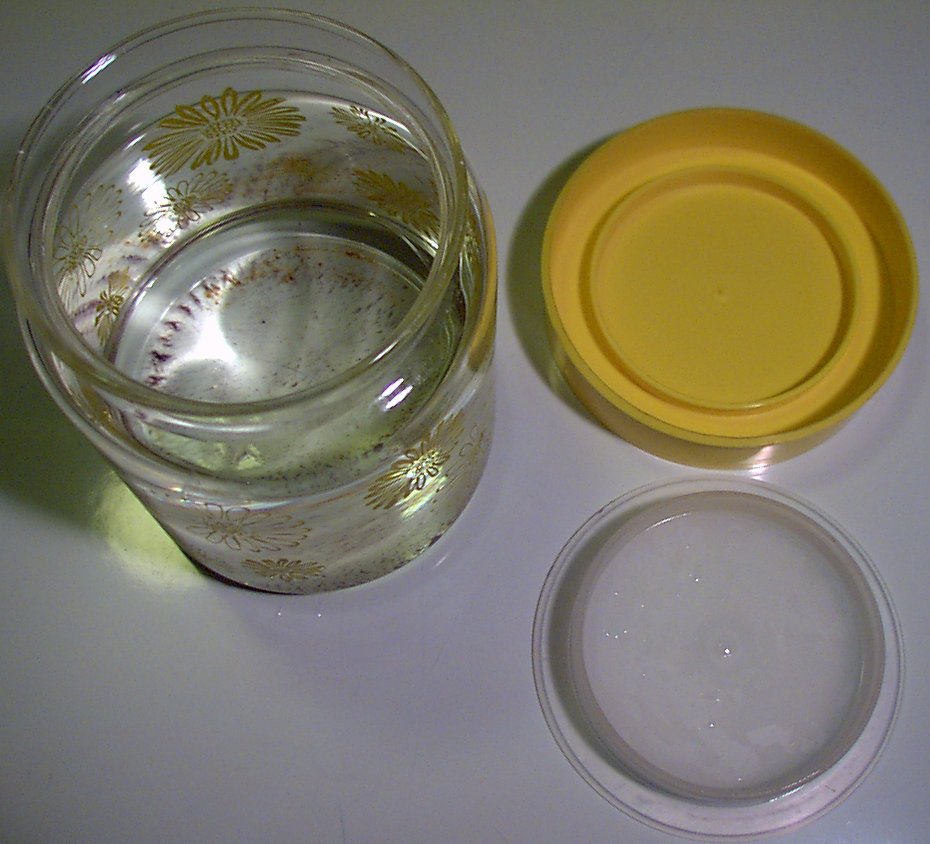
This lid is constructed of an outer shell of hard plastic
and an inner seal of soft plastic. The outer shell is shaped like this in cross
section:
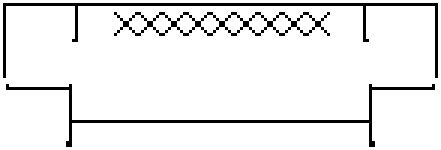
The inner seal is shaped like the lower diagram. If you move
the lower part up to where it fits inside the upper part, the XXs define an empty space between the two parts of the lid.
The lower part makes a seal inside the glass jar and also seals the space
inside the upper lid. There is no easy way for condensation to show up in the
space between the lids. In fact, I checked for moisture in this space before I
put the lid on the jar and put the jar in the metal can where I am storing it.
Jim has often said that monatomic likes closed/tight spaces.
This seemed like an ideal situation for some of the "oil of gold"
condensate to form. This evening I got a wild hair and decided to check the
space between the lids for moisture. The lower lid is sort of like a
translucent Tupper Ware material and I immediately noticed some moisture
between these lids. I took them apart. This was not easy since they are pretty
well sealed together, but just a press fit. There was about a cc of liquid in
the space. I tasted it and it had the oily feel with the sweet taste that I
have come to expect of this type of material.
Immediately after I tasted this I got the spacey feeling
that I have come to associate with these materials.
I sucked up the rest of the liquid with a syringe and put it
in a small vial with a tight lid.
I still
have this sample in my closet so I took it out this evening (
http://subtleenergies.xyz/ormus/tw/tunnel01.jpg
through http://subtleenergies.xyz/ormus/tw/tunnel06.jpg
Still, all
of these observations of presumed "tunneling" behaviors have come from
me or Jim through me. Wouldn't it be nice if there was some independent source
of evidence for tunneling behaviors with these materials? Fortunately, such
evidence showed up in the early summer of 2003 as I was planning to go down to
do some presentations in
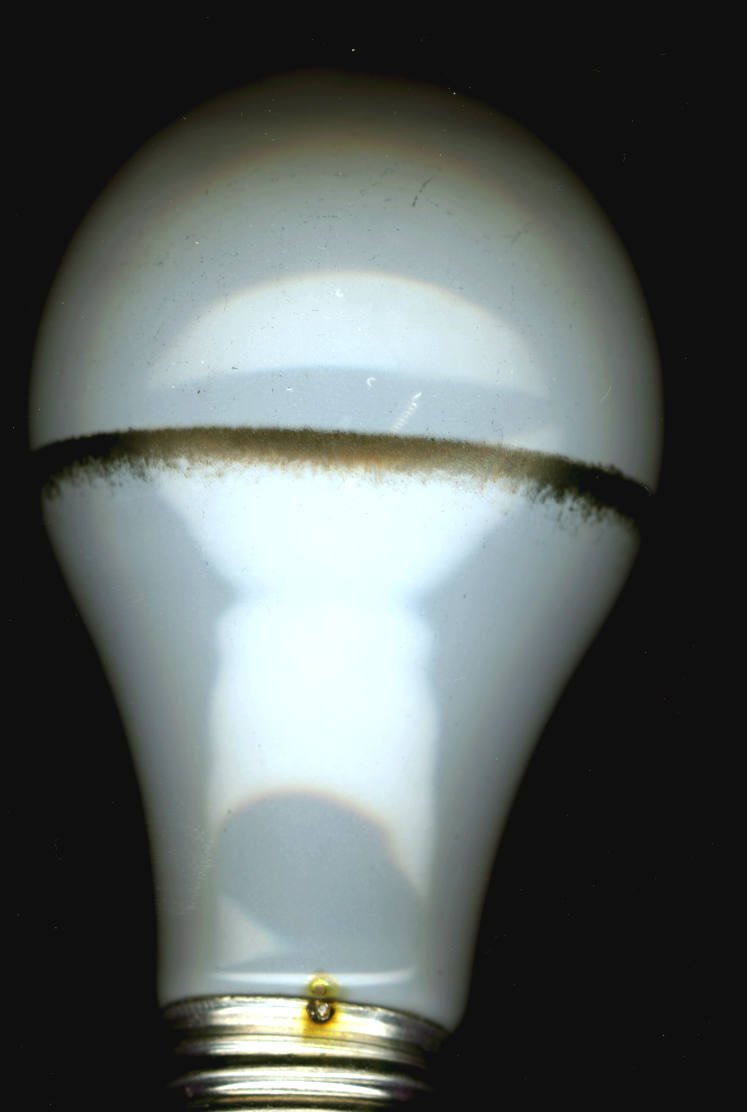
Barry,
Take a look at the attached image. This is the bulb out of
the recessed light fixture over the sink where the filtrates get dumped. Does
this make sense, that the ORM would go metallic around the incandescent
filament? There is no other explanation that I can think of. This stuff won't
scrape off the bulb either. It is like it is in the glass.
Go figure, Chaz
You can see
the image that Chaz got from the light bulb with his
scanner below:
When I got
to Sedona in visited with Chaz for a couple of days.
On July 11th I took another picture of the light bulb. This can be seen below:
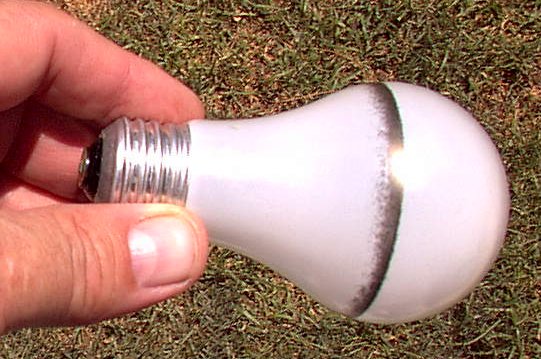
I can
confirm that the metallic plating is not on the outside of the glass bulb. I
was unable to scratch it off with a knife. It also definitely had a gold color
as you can see from the images.
The link
below is to a sound file that I recorded with Chaz
talking about the light bulb:
http://subtleenergies.xyz/ormus/tw/chaz.mp3
On
All of this is in preface to an observation that Thomas made
last weekend (
He also noticed that this rose oil was jelled in the bottle.
It is interesting to note that the rose oil was in a sealed bottle about a foot
away from his operating magnetic trap. You can see a picture of the rose oil
and the trap at:
http://subtleenergies.xyz/ormus/tw/rosegel.jpg

(The rose oil is in the small red label bottle directly
above the large trap.)
Thomas showed me the jelled oil when I returned from my
presentation on Sunday the 12th. Yesterday (Monday) we had a warm day and when
we examined the rose oil it was a liquid again. This morning when the
temperature was about 68 degrees the oil was jelled again. When Thomas held the
oil up to the light and handled it a bit it turned back to a liquid. I did get
a picture of the gel but it does not show up very well in the picture.
In early
2000 I started putting together a document on how to prevent the loss of ORMUS
from the containers it is stored in. This has more examples of presumed
tunneling and can be found at:
http://subtleenergies.xyz/ormus/tw/shielding.htm
Occasionally
we get new examples that suggest tunneling is involved. Here is an example in a
post to the ORMUS forum from Richard on
I do not dry wet method, nor do I boil the water before precipitating
as I have found that even gas or flame heat in excess causes evaporation of
some of the good stuff. This isn't to say it is completely gone, but unless you
have a means to contain it, the ormus can be largely
lost. Some time ago, I tried distilling a batch of wet method and capturing the
result in an apothecary jar of about 3 gallons capacity, with a magnetic
airlock fitted to the receiver. The experiment was successful, but the bottom
fell out of the jar before I could sample it. The water was different, though,
having a sweetness and slippery feeling to the lips. The only reason I could
see for the failure of the jar was the tunneling effect of the ormus. I guess I should have saved the two pieces, as the
bottom of the jar fell off in a near perfect circle leaving the rest intact.
This also happened to a mason jar I used to store some ormus
in. (I still have the apothecary lid though) Some heat
helps the reaction along, and I heat seawater in a water bath (hot water in a
bath tub) before precipitating.
Blessings and Light,
Richard
When asked
about any possible electrical that might have influenced the tunneling Richard
responded as follows on
Yes, my lab bench was right under the main breaker panel
(100 amps) for our house. I subsequently moved it to the opposite side of the
room, in a basement, about 15' away. I also moved my computer terminal as far
as I possibly could, as I was having repeated problems with it. (2 monitors, one quite a good one, one processor and a couple of
boards.) I have had nowhere near the problems since I moved it. I also
placed orgonite in my computer room, and near the
electric box. Due to the rapid succession of failures, I now have a cheap
disposable board until I can afford a better one. I got an RMA on one of the
monitors so I did not have to pay for it, and it included a free upgrade. I
neglected to tell the manufacturer of the probable cause. All my monitors are
fairly hi-rez, so they operate with a higher
frequency than average.
Blessings and Light,
Richard
Another
post from Richard on
The source of my ormus is
Christoff can tell you how pristine the area
is, as I took him there about 4 years ago. I have not found a better source, from
a hundred miles below, to about 400 miles above (northwest). Also the area has more
than a few subtidal thermal vents, which could add ormus to these waters. I have also learned recently, that
magnetic anomalies can originate deep in the magnetic core of the earth,
imparting earth frequencies to the area they influence. The purity of the water
is such that I can run 250 gallons through a white cotton filter with little or
no discoloration and maybe one or two tree needles.
I have been using the salt collected from the water as a
natural food supplement and seasoning as well as the precip
since 2005 and am truly grateful for this source.
Blessings and Light,
Richard
SUPERFLUIDITY
On
The active
materials actually continue to grow over the side of dish if there is an excess
of the oily phase, while nothing more happens with the dead stuff.
On Friday,
February14, 2003 Hank replied:
LOL! I had
that problem in trying to 'dry' my wet gold precipitate by conventional means.
I got it down to a damp crystalline mass and bottled it in a jar with a tight (I
thought) plastic screw top. The stuff kept creeping up the jar walls and under
the cap and down the outside of the jar for months afterward. Finally I got it
to air dry enough that this stopped.
Jim
described an extreme form of superfluid behavior when
he was working with the mine waste water in
http://subtleenergies.xyz/ormus/tw/mystory.htm
QUANTUM COHERENCE
The
evidence for quantum coherence at biological temperatures is generally
subjective though it has been reported by several researchers with mainstream
credentials.
Dr. Mae-Wan
Ho (see: http://www.i-sis.org.uk/about.php for a short bio) has written a
great deal about the role of "quantum coherence" in consciousness. In
the abstract of her article titled "Quantum Coherence and Conscious
Experience" Dr. Ho writes:
"I
propose that quantum coherence is the basis of living organization and can also
account for key features of conscious experience - the "unity of
intentionality", our inner identity of the singular "I", the
simultaneous binding and segmentation of features in the perceptive act, the
distributed, holographic nature of memory, and the distinctive quality of each
experienced occasion."
In her
paper titled "Gaia and the Evolution of Coherence" she suggests that
this same quantum coherence is a fundamental basis for intercommunication
between species on the Earth:
"Thus,
it seems that the essence of the living state is to build up and extend the
coherent spatio-temporal platform for communication
starting from the energy of the sun initially absorbed by green plants. Living
systems are thus neither the subjects alone, nor objects isolated, but both
subjects and objects in a mutually communicating universe of meaning. In
contrast to the neo-Darwinist point of view, their capacity for evolution
depends, not on rivalry or on might in the struggle for existence. Rather, it
depends on their capacity for communication. So in a sense, it is not
individuals as such which are developing but living systems interlinked into a
coherent whole. Just as the cells in an organism take on different tasks for
the whole, different populations enfold information not only for themselves,
but for all other organisms, expanding the consciousness of the whole, while at
the same time becoming more and more aware of this collective consciousness.
Human consciousness may have its most significant role in the development and
creative expression of the collective consciousness of nature."
Also in her
paper she postulates that:
"Organisms
are thus emitters and most probably, also receivers of coherent electromagnetic
signals which may be essential for their functioning."
Dr. Philip
Callahan is an entomologist who has been exploring the mechanisms of this
coherent electromagnetic reception for the last fifty years. Dr. Callahan has
his doctorate in entomology and about 1600 hours of training in electronics. He
has combined these two interests and developed several interesting theories.
His theories are based on experimental evidence. One of his theories is that
insect antennae are dielectric, open resonator infrared detectors. He expounds this
theory in a paper published in the book "Molecular and Biological Physics
of Living Systems" edited by R. K. Mishra and
published by Kluwer Academic Publishers in 1990. His
paper is titled "Nonlinear Infrared Coherent Radiation as an Energy
Coupling Mechanism in Living Systems". Here is his introduction to this
paper:
"A
history of my observations of moths and ants at light is given and the external
infrared environment of day and night described. It is pointed out that insects
have dielectric, open resonator, antennae, in the from of sensilla,
on their antennae. A table of the ELF vibration frequency of various insect
orders is presented and related to the many parameters of infrared scatter
emission from scent and pheromone molecules. Experiments on moth oviposition , attraction to candles, and response to colors
of light are described, as is the behavior of ants at candles. The complex far
infrared maserlike emission of candles is correlated
with emission from insect sex scents and pheromones, and a method of generating
maserlike scatter emission from scent molecules
described. Several such spectrum from ethanol are presented. Spectrum
of nonlinear emission, far infrared frequencies from breath are
generated by vibrating a metal plate with a 130 audio component of the
There are a
couple of quotes from this paper which suggest that the principles that Dr.
Callahan has discovered might be common to many living systems:
"The occurrence of nonlinear coherent lines in breath at
body temperature leads one to the conclusion that coherent radiations,
especially from complex scatter frequencies, are a part of the mechanism of
self organizing biological system and occur as readily, under the right
conditions, in the tubules of the blood vessels and at cellular levels,
especially in the visible region as shown by Popp(17), and others. A summary of
elegant work based on coherence in self organizing living systems is given in
the symposium "Synergic et Coherence dans les
Systems Biologiques."(18) Work on coherent
information and energy transfer mechanisms is a new and exciting area for
research into the mysteries of self organizing biological systems, and it is
the scent coupling of energy from organic molecules to insect dielectric antennae
forms in the infrared region that gives great insight into how such coherent
systems work. It is imperative that researchers in this field answer criticism
from those who are convinced that coherence does not occur at room temperatures
in living systems."
"That coherent infrared is available for insect
communication systems there is and it is also available in both the visible and
infrared portions of the spectrum for utilization in self organizing biological
systems(17), and it is for this reason that my work reinforces other work on
coherent energy coupling mechanisms in living systems.
Once this concept of coherent energy coupling in self
organizing systems is thoroughly understood, it is predictable that the
generation of coherent signals in the UV (virus and membrane dimensions)
visible and infrared (cell, organells and insect
antennae dimensions) can be utilized to resonate to the biological antenna in
order to control disease organisms or reverse cancerous conditions. It might
even be possible to resonate to the form of the AIDS virus in the 0.1 mm
region, which is the dimension of most virus, and reverse the fatal signals of
that small "living" antenna, or to put it in more poetic terms 'find
God in little things.'"
Another
phenomena which is associated with quantum coherence is superconductivity. The
search for a material which will support superconductivity at room temperatures
is one of the "Holy Grail" quests of modern physics but there is
strong evidence that supercondictivity is already present
in biological systems at biological temperatures. In her "Gaia" paper
Dr. Ho wrote:
"Recently,
technology has progressed to materials which can superconduct
at much higher temperatures above absolute zero. The solid-state physicist
Herbert Frohlich (1968) in Liverpool was among the
first to point out that something like a condensation into a collective mode of
activity may be occurring in living systems, such that living organisms are in
effect, superconductors working at physiological temperatures. He suggested
that much of the metabolic energy, instead of being lost as heat, is actually
stored in the form of coherent electromechanical vibrations in the body. He
called these collective modes, coherent excitations."
In recent
years a number of interesting papers have been published which identify the
presence of superconductivity in biological systems
(http://www.ortho.lsuhsc.edu/Faculty/Marino/EL/EL4/References4.html):
Little: W.A. 1964. Possibility of synthesizing an organic
superconductor. Phys. Rev. 134A:1416.
Little,
Ginzburg , V.L. 1964. On surface
superconductivity. Phys. Lett. 13:101.
Ginzburg , V.L. 1968. The problem of high
temperature superconductivity. Contemp. Physics
9:355.
Halpern , E.H., and Wolf, A.A. 1972.
Speculations of superconductivity in biological and organic systems. Adv.
Cryogenic
Wolf, A.A., and Halpern, E.H.
1976. Experimental high temperature organic superconductivity in the cholates : a summation of results. Physiol.
Chem. Phys. 8:31.
Wolf, A.A. 1976. Experimental evidence for high-temperature
organic fractional superconduction of cholates. Physiol. Chem. Phys.
8:495.
Ahmed, N.A.G., Claderwood, J.H., Frohlich, H., and Smith, C.W. 1975. Evidence for collective
magnetic effects in an enzyme. Likelihood of room temperature superconductive
regions. Phys. Lett. 53A:129.
Cope, F.W. 1971. Evidence from activation energies for
superconductive tunneling in biological systems at physiological temperatures. Physiol. Chem. Phys. 3:403.
Cope, F.W. 1978. Discontinuous magnetic field effects (Barkhausen noise) in nucleic acids as evidence for room
temperature organic superconduction. Physiol. Chem. Phys. 10:233.
Quantum
coherent phenomena have been linked directly to the ORMUS materials by
researchers working at Gravity Control Technologies in
GCT Communications research concentrates on utilizing the
information transfer properties of the Zero Point Field as a means and medium
of communication.
During the development phase of the propulsion system it was
observed that two separate plasma powered prototypes exhibited identical and
simultaneous plasma field discrepancies when operated simultaneously. These
simultaneous resonance couplings persisted regardless of the shielding used to
separate the two devices, including Faraday cages.
We believe that it is possible to build custom plasma field
units that are capable of transmitting and receiving messages by
resonance-tuning them through the ZPF. In our view, the exchange of information
between the devices is accomplished through the medium of the Zero Point Field,
and is not dependent in any way on the exchange of conventional electromagnetic
energy.
Real time exchange of information over extreme distances can
be accomplished. For example, communication with a spacecraft orbiting Mars can
be an interactive experience, with no speed-of-light time lag between
transmission and reception.
You can
find this at:
http://www.gctspace.com/research/comm.html
The observations
reported here all suggest that we are working with a form of matter with
properties that are radically different from what we expect at biological
temperatures and at larger than quantum scale. I would suggest that this looks
very much like a form of matter which is not described well by conventional
physics and chemistry.