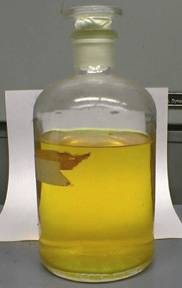
Here is my aqua regia dissolution/recycling
bottle with some gold in
solution, and some throwbacks recycled
from the process.
Safety First!!
This work consists of strong acids! These
acids emit corrosive and toxic fumes. At some point in the work, other
toxic fumes are emitted. Wear protective gear, rubber gloves, eye protection,
etc. I started my work in a heavily ventilated garage-like building. It
soon became apparent that the fumes were corroding exposed metal in the
building, despite the heavy ventilation. I moved the work outdoors on a
card table during good weather to do this. Be aware of the wind direction!
Stay upwind of the work! I have had some experience in working with strong
acids in chemistry classes, so I felt confident of my safety precautions
and knowledge of how to handle these caustic acids. This is not for the
chemically inexperienced! I cannot be responsible for any harm that may
come to you if you try this.
Use no metal!!! No metal pots, spoons, stirrers.... nothing metal touches the work! Pots shall be glass. Spoons or stirrers should be glass or 'Teflon' (HDPE) or other acid-resisting nonconductive material. I used one of the golden tan Corning Pyrex saucepans. It has a nice pouring lip, and a glass cover. The pouring lip will still allow fumes and steam to escape even with the cover in place. This pot and a single element electric hotplate were picked up used, cheap, at a swap meet. Consider them disposable.
Read the entire patent process carefully. Understand it. 'Know it'. I meditated on it for quite some time before beginning. One thing becomes clear... that gold molecules tend to 'cluster' in various sizes, some very large. For our work, we want to break these down to the smallest possible sizes and eliminate the large clusters. Note that at the end of the work, when the pH is adjusted, the presence of any large gold clusters will 'pollute' the final output, which must then be recycled back into aqua regia, and you must start all over again!
I started with a glass reagent bottle with a glass stopper to contain the acids. I mixed my own 'aqua regia' of nitric and hydrochloric acids. There is no 'proper' ratio of the two that is really correct. Again, Hudson notes that the gold metal-plating industry has found that less nitric acid in the mix yields more metallic gold for plating from the resultant gold chloride. The implication here is that more nitric acid in the aqua regia will break the gold down into smaller clusters of gold chloride, with less metallic 'clustering' fallback. This is what we want. My mix was rich in nitric acid, roughly one-third HNO3 by volume.
Here is my aqua regia dissolution/recycling
bottle with some gold in
solution, and some throwbacks recycled
from the process.
I opted for a near-saturation dissolution of 1.10 ounces of pure gold, consisting of Canadian Maple Leaf bullion coins (1oz. and 1/10 oz.) into 333 mL of aqua regia. Maple Leaf coins are 99.9% pure gold. (Do not use American Eagles, or other alloyed coins. Eagles contain silver and copper with the gold.) This can take several days to dissolve. (I wonder now if letting it digest longer will break the clusters down even smaller?) My reasoning at the time was that with a gold-saturated solution, I would get a better yield on the output. Now I'm not so sure, since the saturated solution seems to have an awful lot of larger clusters that keep recombining as metallic fallback and must be redissolved or removed. I did not use all of the dissolved gold/aqua regia in the following experiments. I started with just a small amount for the first test batch, so as not to waste a lot of gold if something went wrong.
Steps (2) through (5), the initial boildowns and additions of HCl must be repeated many, many times. It goes from red acid liquid to dark red-brown crystals of gold chloride. Everything this stuff touches, from the smallest spatter, will turn purple! The act of forming the crystals is seemingly what breaks down the larger clusters, and it must be done over gentle heat. When it starts to crystalize, reduce the heat to the minimum needed to evaporate the acids and crystallize the rest. Too much heat at this point tends to make the gold clusters recombine as metallic 'sponge' that you can see shining in your pot. This will happen anyway, even if you are gentle with the heat. Add more aqua regia to dissolve it all again, and boil down again and again with only HCl. You need only add enough acid to dissolve the crystals again, and then boil it down to crystals again. I repeated this process at least eight times, maybe more. Each time seemed to get less and less gold metallic fallback. At one point in the latter boildowns where the metallic clusters began to reappear, I stopped, cooled, and let the gold settle. Then I decanted the liquid into a fresh pot, leaving the gold clusters behind. These were recycled back into the aqua regia 'dissolving bottle' for later attempts. You may stop down the process at the end of any boildown, cover the pot, and store it until the next work session.
Understand here that you are attempting to break apart the large clusters. You must repeat the process many times. The gold will want to recombine into large clusters... just break it down again. In the end, resort to mechanical separation of the large clusters that fall back to metallic state. This gets real boring as you are doing boil-downs over and over, and consuming a lot of concentrated acids...especially HCl.
(Sung to the tune of '99 bottles of beer on the wall' :)
99 atoms of gold in a ball, 99 atoms of
gold.
Crack one down, dissolve it around,
98 atoms of gold in a ball!
(Repeat)
---------------
When you are finished with the song, your gold will be ready! :-)
It is most important to realize that these gold-cluster breaking reactions are not a complete chemical reaction! They can best be characterized as cascading reactions working on many different size molecules, and they do not all break down to the smallest sizes. Indeed, some seem to want to build back up to sizeable clusters. What we are doing here is 'sifting' down for the smallest clusters, and removing the larger clusters. This might be easier if we do not fully saturate our first aqua regia with gold metal... I don't know.
The next step (6) is addition of sodium chloride and water. This is again boiled down to almost dry. This crystallization process also breaks apart the smaller gold clusters and yields the monatomics! These steps, (6) thru (8), must also be repeated ad-nauseum, the more the better! It is boiled down first with water and crystallized, then dilute HCl is added and boiled down, then water, then acid. Each time you will note the color becoming lighter and lighter, from orange through lemon yellow and pale yellow. Now here's a trick I used... mechanical separation.
As you boil down, the salt crystals will emerge. The yellow liquid tends to concentrate at the bottom of the pot and gets a darker orange-red as it concentrates. This is the larger gold chloride clusters that are not broken down! After several iterations of the boildown, when it seems no more color change (lightening) is occurring, decant this colored liquid from the white crystals, and recycle it to the aqua regia bottle. At one point I boiled the crystals too dry... and slightly baked the bottom of the pot. What I got was a dark red ring of chloride clusters fallback in the bottom of the pot. I stopped, cooled, and removed the crystalline mass 'cookie' from the pot. Then I scraped off all the red chlorides and recycled them to the aqua regia dissolution bottle. The remaining snow-white salt crystal mass was again dissolved and crystallized to insure no color changes or large cluster fallbacks were occurring. Once dissolved in water, I also ran the clear liquid through average filter paper to remove any gold clusters or large debris. The monatomics in solution here are very, very small and will go right through average filter paper. Coffee filters work good for this in the water solution. Do not attempt to filter the acid solution! It will eat up your filter paper!
You MUST have snow-white salt crystals when you are done with this stage! Any chloride discoloration here will pollute the output when the pH is adjusted. If that happens, you start all over again, to the tune of '99-boildowns'! Get those salt crystals white... even if you have to scrape the red off of it!
The pH adjustment of step (9) requires constant stirring, and can take several days. I invented a stirrer out of a length of Teflon tubing, flayed the end, and attached it to a cheap battery motor suspended over the pot... with a motor speed control attached to vary the speed. I obtained an inexpensive 'Pocket pH Meter' from a chemical supply house. I also found that the pH sensing element was confused by the presence of the monatomics and required frequent rinsings. I did not leave it in the pot, just dipped it for spot-readings. Eventually the replaceable sensing element was eaten up by this stuff. Go slowly in adjusting the pH. It will move a lot at first, and then more slowly. Let the pot stir for a long time and check the pH again... it will move slowly in the latter stages. Be patient. Much like the cascading crystallization process above, this does not all happen at once! Follow the directions in the patent, and bring it up gently to a 7.0pH and check that it stays there for 12 hours of stirring.
The next step (10) is the addition of nitric acid to remove the chlorides of the salt crystals. BEWARE of the fumes this produces... thick, brown, and noxious! (You ARE working from the upwind side of the table, yes?)
Finishing the process off, you may not see the precipitate that is mentioned in step (16) of the patent. If you obtain clear liquid, you are doing fine! Filter out any black or gray solids with average filter paper.
Here I diverge from the patent. I spent a horrendous sum on the 0.45 micron filter paper, only to find it terribly inefficient for filtering out any but the tiniest quantity of the precipitate. It has such small, fine holes that it clogs up immediately with precipitate. After waiting several days for a funnel full to drain, I decided that there was more evaporation taking place than filtration. This is a problem for a large batch like I was making.
Instead I just boiled down the precipitate to remove most of the water. When your clear water starts to turn milky and thickens like pudding, you will know you have the right stuff! Cover the pot and boil gently. The stuff tends to splatter! Hudson said that the ancients used to call this stuff the 'semen of God'. One look at this pot of slime and you will know why that description is apt. What you are left with is the hydrogen auride precipitate with water. I did not perform steps (19) through (21) to reduce it to dry powder.
First, I could not afford the vacuum furnace needed for the dry powder production. Secondly, I reasoned that the precipitate would be easier to store, and since it was moist already, that this is the form that would be most easily ingested for the body water to use and disperse.
Scrape the pot out with a nylon spatula (No Rubber!) into a brown glass jar with a tight fitting plastic screw on lid. Do this immediately while it is still warm and keep it sterile! This stuff is a biologically active food. I left a glass tumbler of a mild water solution with some of this precipitate in it. The water grew a healthy head of mold in a few days, with streamer roots all the way to the bottom of the tumbler.
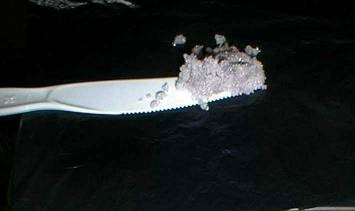
I dug into the 'brown bottle' today and chopped up some of the damp crystalline precipitate for a picture. I had forgotten the color. It is a slight purple-grey in color... not quite white. Here is an image of it on a white plastic knife, against a black plastic background:
Plant experiments, and taste tests
The first batch I made was a small quantity to test the process. My guess is that I used approximately one-tenth of the dissolved gold/aqua regia solution, or maybe about 1/10 ounce of dissolved gold.
Once I had the output safely stored for future tests, I wondered about it's toxicity. I had some cleanup to do, and I hated to waste even the tiniest amount of m-state pot-rinsing, so I decided to try a plant experiment with the waste.
Aloe vera grows wild in this area. About two years before this experiment I had transplanted a small aloe plant to this worksite in case I needed it for an industrial burn or cut. Aloe juice is used as treatment for skin burns.. The plant did poorly for two years after transplantation. The spot I planted it was somewhat dry, and I had to throw water on it when I would visit to encourage it to grow. It did not substantially increase its size in two years.
Some companies are selling healing compounds extracted from aloe plants which are suspected of concentrating monatomics from the soil into their gelatinous leaves, so I thought that by dumping my monatomic-bearing pot rinsings on this plant I would test its toxic effect on the plant or see if it promoted growth. It did!
In a couple months, the aloe leaves swelled and greened up. The plant continued to grow from the crown. In about six months, the plant 'calved' and two more small plants sprang from the side base of the mother plant. A year later the mother plant grew a flower stalk and bloomed! This is rare in this region, and I had not added any water to the plant as I did in the past. The aloe was surviving and thriving on its own in this difficult environment. This is one of the things that encouraged me taste a tiny sample of the monatomic gold.
That was four or five years ago. This year the plant(s) continue to grow and thrive with no additional monatomics or water other than intermittent rains. It grew another flower stalk this year, which divided into three flower heads! This is dramatic growth and life-force! I am sure that this plant is full of healing monatomics now, should I ever need it.
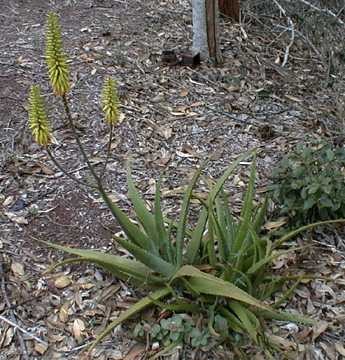
Here is an image of this healthy
little plant
First taste tests
I observed the aloe for several months to be sure it would not die. I also left a solution of the precipitate out in an open glass tumbler for several days. Suddenly there was mold on the surface of the water, with streamer roots to the bottom of the tall glass tumbler! This stuff clearly feeds and supports life! So I decided to taste it.
I took the smallest little crystal I could break off from the mass... maybe half of a rice grain in size, and put it under my tongue. At first it has a brief 'ionic bite' (Probably the effect of the hydrogen atom?) and then I noticed a salty flavor... sodium chloride traces were still there, but not very strong. The crystal dissolves immediately to a gelatinous mass that keeps on dissolving into liquid. It is slippery and spreads fast throughout the liquid in the mouth. I could feel it penetrate the soft tissues under my tongue and around the gums. The effect was refreshing, as if these tissues were being oxygenated with a blast of fresh air.
I felt it penetrate under my tongue, and I sat quietly, observing myself, almost meditative in mood, not knowing what might come next. The effect was quite subtle. I got somewhat more meditative, but I found that when I focused my attention things became sharply lucid. I was prepared for something dramatic, but it never came at first taste. It just seemed to sharpen my awareness, wherever I directed it to.
By this time I was working on the boilings of my second pot. Now I am working with half of the remaining aqua regia solution, or roughly one-half ounce of gold in solution. I waited a week or two after my first ingestion, but did not suffer any ill effects. It seems to wear off in a day. Then I cautiously increased the dose in small amounts. I had three or four tastes now, and found that increasing the portion size made me very aware, and nervous, as if I had too much strong coffee. The only difference seemed that the m-state precipitate did not raise my heart rate like the coffee does. I would go out for a brisk walk to deal with this 'consciousness rush' and just enjoy watching the world go by as I walked through it.
After producing my second pot of the stuff (from 1/2oz. of pure crude gold) and scraping the pot clean, I decided to rinse the pot with distilled water and drink the rest, figuring it to be a couple rice-grains worth of residue. That night I lay awake in bed, restless. Sleep was difficult. My backbone and spinal cord were itchy, and my adrenalin levels were rising in fear. What had I done to myself? Finally, I just stopped trying to control or suppress the feelings and relaxed and let it come on. I shuddered, and had what can only be described as a Kundalini experience that shot through my spine and exploded in my head... and beyond. Meditators have tried to attain this experience for years. I was never that devoted, but I had read of the experience.
I am still curious about the timing of the Kundalini. It came on all by itself in the middle of the night, approximately six hours after ingesting the m-state pot rinsings. I did no meditating. I wonder if the timing of the onset had some external, or cosmic cause. It was close to midnight. After the shudder, I lay stunned, amazed, for a moment. When I realized I was alive and seemingly undamaged, I asked myself 'what was that?' Descriptions of the Kundalini came to me immediately, and I deduced that is what it was. With this realization I chuckled, relaxed, and had a wonderfully restful sleep for the rest of the night.
I have not repeated that experience, nor that heavy a dose. I 'nibble' at the stuff very intermittently. I still have most of that second batch of precipitate, and there is another 1/2 ounce of gold in solution for these past five years... awaiting the boils.
I'm consuming all the information on Barry Carter's site now, and I think I will put together a vortex trap and see what I can concentrate out of our volcanic-rock-filtered water in Honolulu. I'm studying alchemy also... but that is a long-term project.
Question - Would you care to relate how you feel after 5 years of consuming the m-gold?
I've been only a very intermittent consumer of the stuff after my kundalini experience. Clearly I have some more inner work to do to learn to handle the ormus better. I've recently been exposed to a Taoist Inner Alchemy technique of circulating chi, ching, and shen... the 'Three Gems', from an alchemist friend. I'm using this to clear my chakras and inner pathways.
I've also discovered from a chelation doctor in the past year that I carry a heavy toxic mercury load from my amalgam fillings. I'm working on getting that removed now, with mercury chelation to follow. My concern has been possible interactions with the ormus, so I have not consumed any lately. In comparative tests with other ormus workers/users, I seem to be very sensitive to it. I know of one fellow who consumed three times what it took to induce the kundalini in me, and he used that dose and some mental techniques to heal an arthritic knee from a 30-year old skiing injury.
Sometimes my body craves, or maybe the ormus 'calls'. I have found that larger doses of it tend to make me nervous, kind of like too much coffee, except that my heart rate does not increase like caffeine induces. I can only describe it as a 'consciousness rush'. One does not want to be around crowds or vexatious persons when one does this... it really jangles the nerves. Usually I will ingest just a grain or two for a gentle, meditative lift. It's nice to do in a quiet meditative setting. It helps the focus of the quiet mind.
I find that telepathic experiences and synchronistic experiences with other people I am in tune with will increase in frequency while on ormus. I've had a few others say 'I was just thinking about that...' when I communicate.
One really does become in tune with the universe, and the universal mind. Neil's ponderings of the 'divinity' aspect of the universe come to mind. I believe the Penrose-Hameroff theory of quantum consciousness based in the microtubules of our cells is the correct one.
http://www.consciousness.arizona.edu/hameroff/
Ingesting ormus increases the superconductive quantum activity in our microtubules, and opens the pathways to an infinity of universes, and answers.
Peace and Aloha,
NaKaula