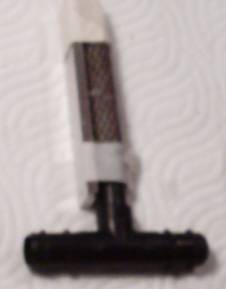
Should it be a Vortex trap or a T-type one?
The answer we should give is: “But a T-type of course!”
And here is why:
a. T-type
watertraps are easier and cheaper to
construct and
it’s also easier to find the proper materials.
b. The vortex trap loses easily its efficiency if the central hole is not perfectly centred.
c. T-type watertraps are easier to add stages to (and make them stronger and stronger).
d. The T-type Watertrap is purely a magnetic trap, but the Vortex works in a double way. It is mainly a centrifugal trap and secondly a magnetic trap.
b. The vortex trap loses easily its efficiency if the central hole is not perfectly centred.
c. T-type watertraps are easier to add stages to (and make them stronger and stronger).
d. The T-type Watertrap is purely a magnetic trap, but the Vortex works in a double way. It is mainly a centrifugal trap and secondly a magnetic trap.
The thought behind the centrifugal principle was to take advantage of the antigravity phenomenon that sometimes takes place on ORME.
Unfortunately this few years of experience with Ormus have shown that this phenomenon doesn’t happen very easily.
Most of the times even if Ormus loses some of its weight, it’s still very heavy. Don’t forget that we have to compare with the molecule weight of water (16+2=18). This is very light! If we consider that we deal with the atomic weight of Ormus-metals (197.2 for example for Gold – not to mention the possibility of Ormus being diatomic-2x197.2 or triatomic-3x197.2 etc ). How much of its normal weight should it lose so that the centrifugal coefficient of the trap will be positive? Instead of collecting them it could even drive them away!
Things are even worse when we work with seawater. Since seawater is not chemically neutral, many of the Ormus may be bonded to heavier molecules.
2. Which are the rules for constructing a strong T-type WaterTrap?
a.
The
first rule is the most simple one:
Prefer Neodymium magnets to Ceramic ones.
They are more expensive but they are much stronger. If you can’t find them or can’t buy them don’t get disappointed. You can come to the same quality of water but with a slower flow.
b. The second rule is the most difficult to explain:
Follow the correct architecture.
What does this mean?
Prefer Neodymium magnets to Ceramic ones.
They are more expensive but they are much stronger. If you can’t find them or can’t buy them don’t get disappointed. You can come to the same quality of water but with a slower flow.
b. The second rule is the most difficult to explain:
Follow the correct architecture.
What does this mean?
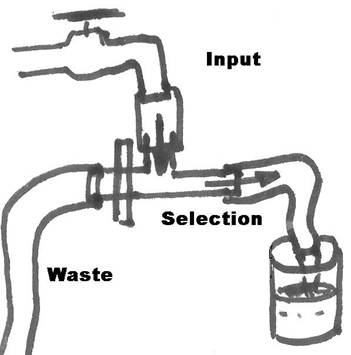
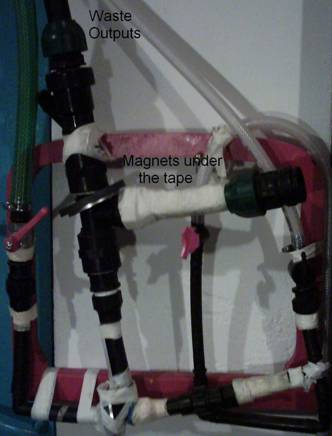
Well, you simply put a donut magnet on your T connection and now you have two outputs: The “waste water output” and the “selection water output”.
Obviously the “waste water” must come from the side were the magnet is.
Correct.
But now you have three possibilities. All three work but only one of them works efficiently.
Unfortunately you can find all three on the Internet as suggestions for trap constructions.
But which is the correct one?
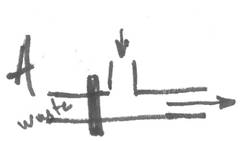
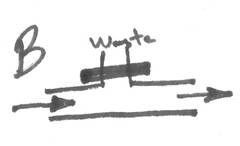

Fig.1 Which one?
The Golden Mirror
We shouldn’t let theory steal our time, but I will only say two things very briefly:
Every conductor has these three characteristic properties that we all know from school: R, L and C*. L is the “coil like” property and it’s easy to remember that when a coil reacts to an induced magnetic field (H) its reaction (-H) is on the same axis with the first field.
The main difference with Ormus is that R=0. We deal with a superconductor. This means that the loop currents that create the reacting field don’t fall instantly to zero and “H” is steadily reflected on the Ormus mirror producing a Force (F) that repels Ormus away.
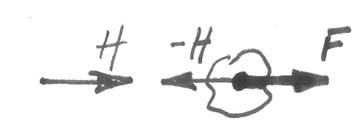
Fig. 2 Field and Force Geometry
· In years to come we expect to find more about the “C” property of Ormus but we don’t expect it to be as useful as “L” is (how many electrostatic speakers do you Know?).
Having understood the above we conclude that from the three possibilities, “A” (from Fig.1) is the correct one. (It’s the only one where the magnet pushes Ormus directly to the selection output).